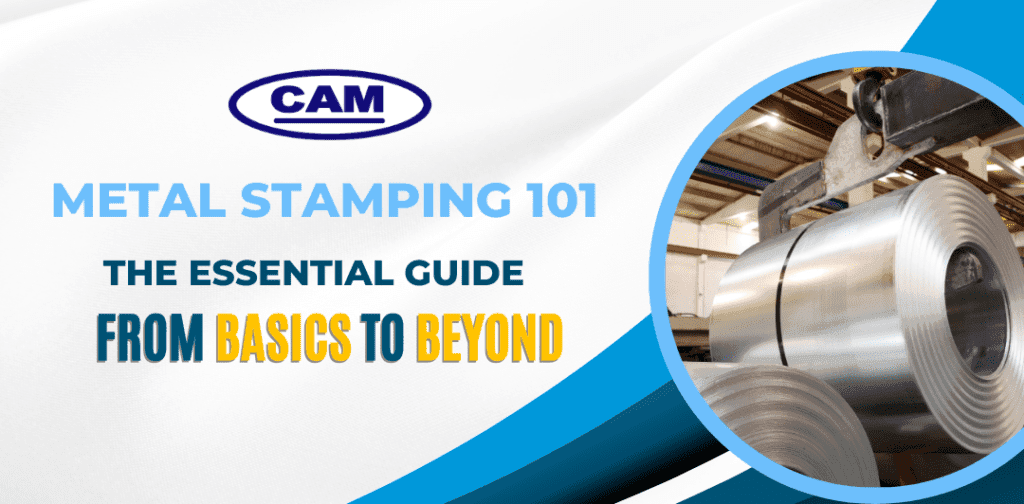
Metal stamping is one of the most reliable manufacturing techniques used to transform flat metal sheets or coils into precisely shaped components. Through a series of mechanical processes — punching, blanking, bending, coining, embossing and flanging — stamping presses and customised dies turn raw stock into finished parts at scale.
Understanding metal stamping
At its core, metal stamping uses a press to drive a punch into a die cavity, deforming or cutting a metal blank. The four key components are the binder (blankholder), punch (upper die part), die cavity (lower die part), and the sheet metal blank itself.
The blank is placed between the dies, secured with a binder, and the punch is driven into the cavity to shape the metal. The result: precise, repeatable parts at production speed.
Making the dies
The process begins with CAD/CAM design using 3D modeling. From there, the die is machined, ground, and refined with wire EDM to produce the tooling that will live inside the stamping press for thousands or millions of cycles.
Precision in every cut: the process unveiled
Metal stamping isn't a single operation — it's an orchestrated sequence of five fundamental processes:
- Blanking — separates the desired shape from the metal sheet using die sets
- Punching — creates holes, notches and geometric features
- Bending — deforms the material to achieve specific angles and shapes
- Coining — applies extreme pressure to create fine features and tight tolerances
- Assembly — combines stamped components using welding or fasteners
Types of metal stamping
Different volumes and geometries call for different stamping methods:
- Progressive die stamping — multiple workstations for efficient, high-volume production
- Fourslide stamping — four simultaneous tools for complex parts in smaller quantities
- Deep draw stamping — punch-and-die action drawing sheet metal into deep, cup-like shapes
Applications across industries
Metal stamping is everywhere precision components need to be produced at scale:
- Automotive — body panels, brackets and chassis pieces
- Electronics — precise, intricate components produced at high speeds
- Aerospace — uniform parts with strict precision requirements
- Appliances — mass-produced consistent parts for home appliances and kitchenware
Partnering with CAM Resources
Whether you need progressive dies for high volume runs or specialised tooling for precision parts, CAM Resources brings 20+ years of experience and modern machining technology to deliver high-quality precision dies on time.