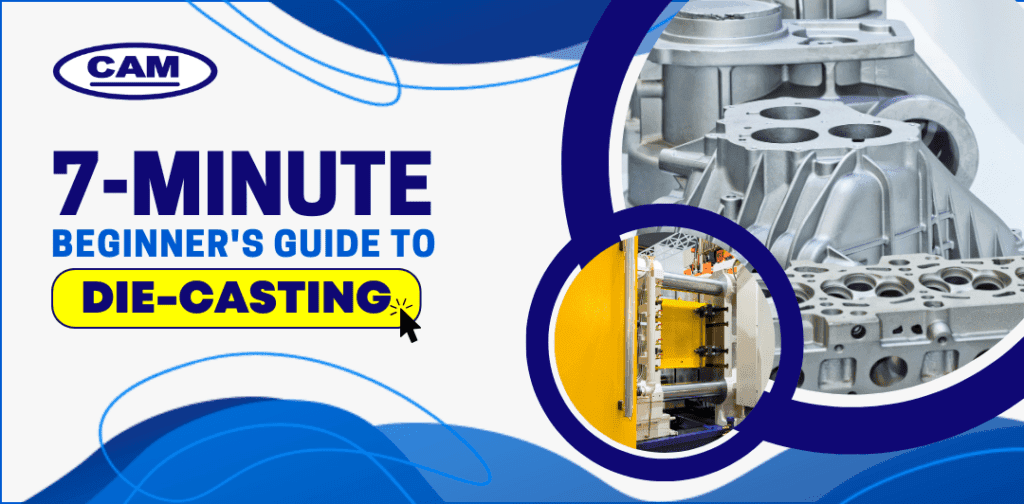
Die-casting is the manufacturing process behind countless everyday objects — from zippers and bike gears to smartphone bodies. It's where liquid metal meets high pressure, transforming into components that drive innovation across industries.
What is die-casting and how does it work?
Die-casting is the process of injecting molten metal into a custom-designed mold — known as a die — to create highly detailed and precise components. The die consists of two halves that clamp together. Molten metal (typically aluminum, zinc or magnesium) is injected under extreme pressure, hundreds to thousands of PSI.
This high-pressure injection ensures the cavity fills rapidly and replicates fine details accurately before the metal solidifies. The mold then opens to eject the finished part, ready for the next cycle.
Compared to traditional machining, die-casting produces complex shapes with intricate details while maintaining excellent dimensional accuracy and repeatability — making it ideal for mass production.
The evolution of die-casting
Die-casting has roots going back to 1838, when Sturges patented the first die-casting machine in the United States. Early commercial use focused on producing printing type. By World War I it was being used for military equipment manufacturing. Today, die-casting serves automotive, aerospace, electronics and many other industries.
Types of die-casting
There are two primary methods, each suited to different metals:
- Hot chamber die-casting — the die is immersed in molten metal, ideal for low melting point metals like zinc, tin and lead. Offers high efficiency and rapid production.
- Cold chamber die-casting — molten metal is melted separately and ladled into a cold chamber before injection. Suits high melting point metals like aluminum, copper and magnesium.
Why die-casting?
Four advantages make die-casting hard to beat for many applications:
- High precision — complex geometries and thin walls reduce the need for secondary machining
- Cost efficiency — intricate shapes at high speed support mass production with minimal waste
- Strength and durability — exceptional strength-to-weight ratios under high temperatures and stress
- Versatility — accommodates a wide range of metals and alloys
Industrial applications
Die-casting touches almost every advanced manufacturing industry:
- Electronics — components with excellent heat dissipation for smartphones, laptops and gaming consoles
- Automotive — engine components, transmission housings and structural elements
- Aerospace — engine, landing gear and structural components where strength-to-weight matters
- Home appliances — die-cast parts in refrigerators, washing machines and air conditioners